
Approximating Via Characteristics
Approximation, in addition to a heap of other good practices, will usually lead to a working system.
Lets say I have a signal that is X GHz, is there a specific anti pad size to ensure I have correct signal propagation?
Does the anti pad only add a delay or extra capacitance?
(Originally on EE StackExchange. Minor revisions for clarity.)
"Correct" signal propagation is quite a difficult thing to quantify without knowing exactly what you are looking for.
Varying the diameter of antipads will indeed vary the parasitic capacitance, which, depending on what you are looking for, may be acceptable or even desirable for maintaining line impedance.
in High-Speed Digital Design by Johnson and Graham provides, by their admission, a very coarse estimate for this capacitance. This model approximates the via as a coaxial, simplifying the geometry and omitting fringing fields (Equation 7.6),
where D₂ is the clearance hole/antipad diameter in inches, D₁ is the via diameter in inches, T is the board thickness in inches, εr is relative permittivity1, and C is the via’s parasitic capacitance in pF.
And for inductance in nH (Equation 7.9),
Where h is the via length in inches, and d is the via diameter in inches.
They go on to use their capacitance approximation to give a coarse estimate of the rise time degradation by the via in ps (Equation 4.76),
where C is the via capacitance in pF, and Z₀ is the characteristic impedance.
The Saturn PCB Toolkit also has a via calculator that can make estimates for these values with IPC-2152 specified models.
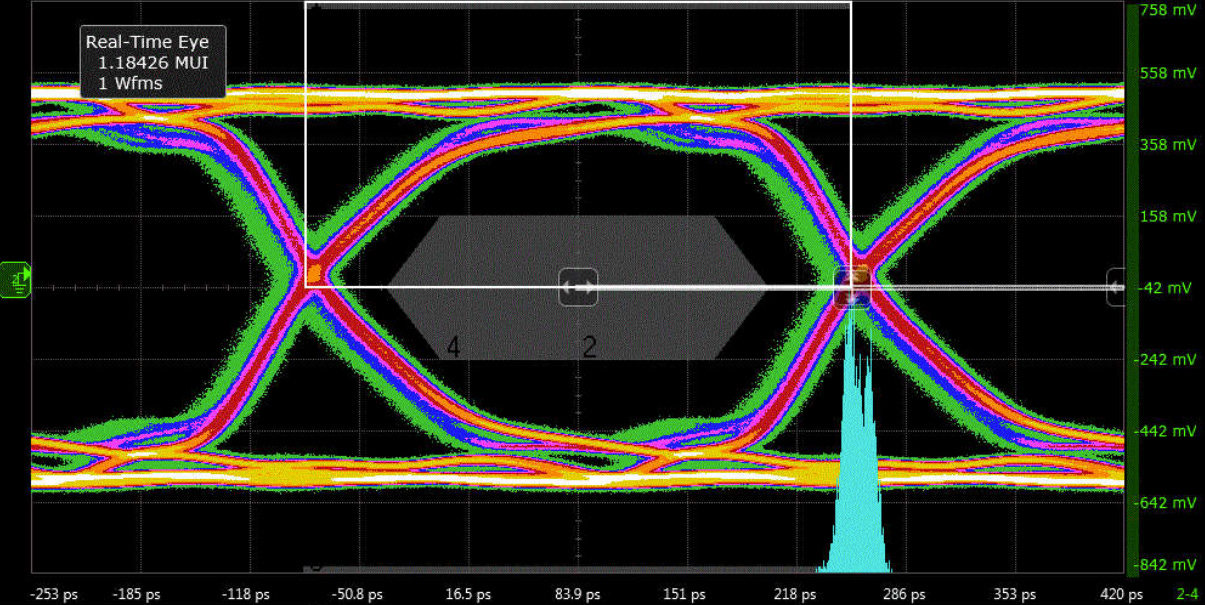
Thus, given that, you can find a comfortable rise time for which the eye width of your whole system is acceptable with the addition of jitter. Every standard will have some guidance for when the signal must be settled, which ultimately translates into a diamond, usually called an eye mask. This report from Diodes Inc., seemingly exported directly from their 25GHz (!!!!)2 oscilloscope, provides some realistic values for an HDMI 1.4 interface, including showing the aforementioned eye mask on page 6.
Realistically, using simulation software like ADS is the best way to get a good picture of your signal integrity before fabrication and testing. So many approximations and empirical formulas are needed to characterize a whole link that the guidance they provide can become inaccurate by the end of a long chain of elements.
Barring that, this approximation, in addition to a heap of other good practices, will usually lead to a working system. The books High-Speed Digital Design and High-Speed Signal Propagation are typically considered a good primer on this subject. These books are aging, but still contain excellent advice.
The book calls this permeability, but I don’t think they meant to bring magnetism into this, as they prove in the latter half of page 257 by substituting 4.7 for this value.
4x $33,000 20GHz active probes and an oscilloscope with an MSRP nearing $230,000, not to mention options.